

How to Start a Cyber Security Career Without a Degree
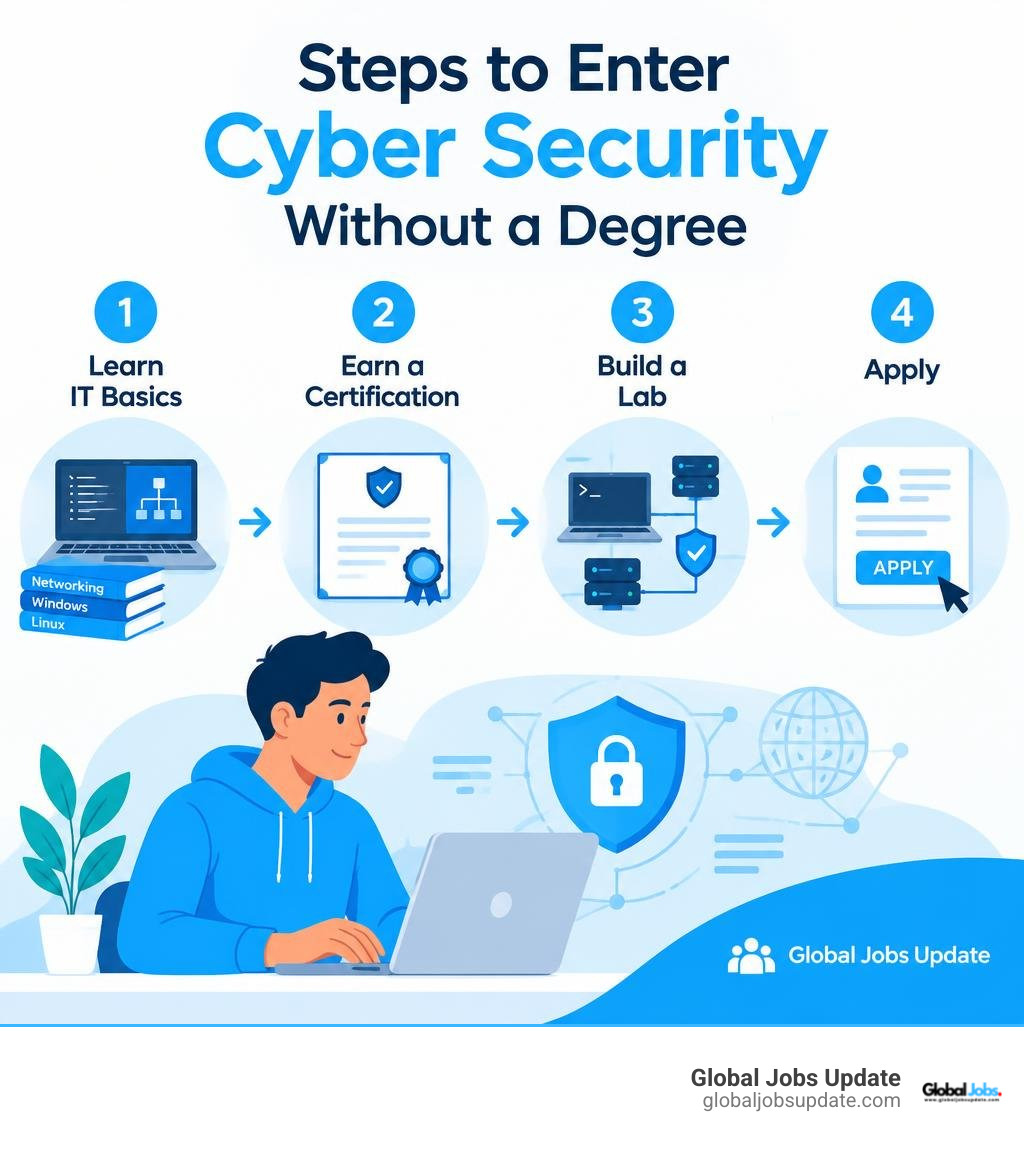
You can get into cyber security without a college degree. Start by learning basic networking, Windows and Linux, then choose a first role: IT help desk, a junior security operations center (SOC) analyst position, or a compliance assistant job. Earn one relevant entry-level certification, such as CompTIA Security+, and build a small lab project you can explain in an interview.
A certificate alone may not get you hired. Employers also want to see how you solve problems and communicate what you found. If a security role is out of reach today, IT support can give you paid experience while you keep learning. For many entry-level cyber security jobs no degree is required if you can demonstrate foundational knowledge and troubleshooting skills.
I’m Weldon Keni, founder of Global Jobs Update and a career content specialist with more than eight years of experience tracking hiring trends and testing job application processes. I use that work to turn complex career paths into practical, actionable steps.
Explore related entry-level opportunities:
- cyber security jobs for freshers
- aws jobs entry level
- construction jobs hiring no experience
Top Cyber Security Jobs No Degree Holders Can Land in 2026

The global tech landscape has evolved dramatically. Today, finding viable cyber security jobs no degree required is standard practice across major enterprises, defense contractors, and managed security service providers (MSSPs). In 2026, severe talent shortages and high-profile data breaches have pushed hiring managers away from traditional degree requirements toward verifiable technical capability.
When security teams need professionals to monitor network anomalies, manage compliance audits, or patch active vulnerabilities, diplomas take a back seat to proven skills. If you are exploring entry points into the field, reviewing the easiest cyber security roles for beginners helps narrow down the exact path that fits your current technical strengths.
The most accessible specializations for candidates without a computer science background include:
- SOC Tier-1 Analyst: Frontline monitoring of security alerts, triaging suspicious activities, and escalating verified threats.
- Vulnerability Management Analyst: Scanning corporate assets for known CVEs (Common Vulnerabilities and Exposures), prioritizing risk levels, and coordinating patch cycles.
- Governance, Risk, and Compliance (GRC) Analyst: Reviewing IT controls against regulatory standards (such as ISO 27001, NIST, or HIPAA), managing third-party vendor risks, and maintaining audit logs.
- Identity and Access Management (IAM) Coordinator: Provisioning user privileges, enforcing multi-factor authentication (MFA) policies, and monitoring directory permissions.
- Security Awareness Coordinator: Creating anti-phishing simulations, organizing employee training, and writing non-technical educational materials to minimize social engineering risks.
Best Entry-Level Cyber Security Jobs No Degree Pathways
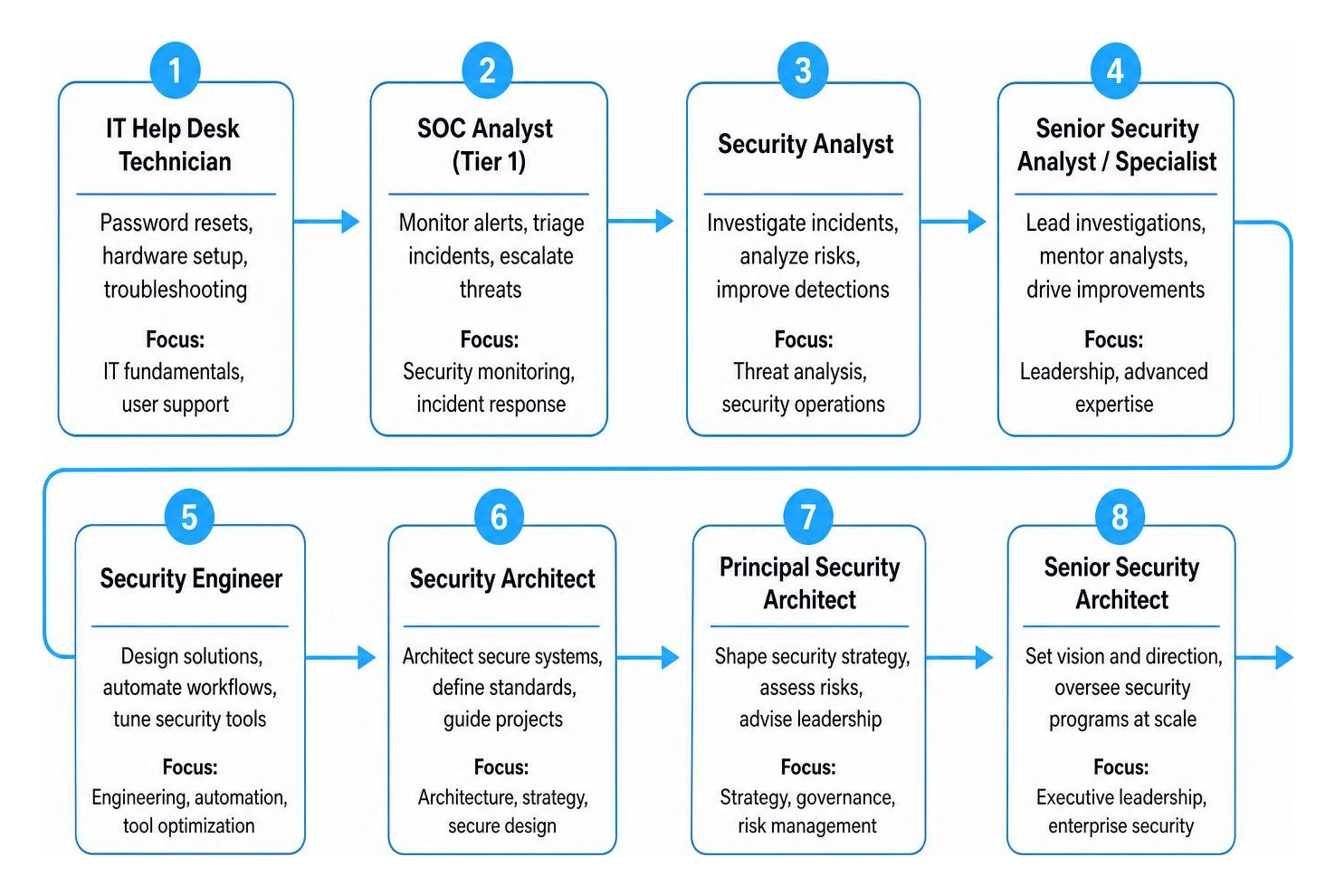
You do not need to leap straight into a high-pressure security team on day one. Many successful professionals enter through adjacent IT roles that serve as natural stepping stones. Working on an IT help desk or as a junior systems administrator provides daily exposure to active directories, firewalls, network protocols, and troubleshooting workflows. These support roles pay you while you develop hands-on technical proficiency.
| Job Title | Average Entry-Level Salary | Primary Daily Responsibilities | Essential Prerequisites |
|---|---|---|---|
| SOC Analyst (Tier 1) | $55,000 – $75,000 | Triage SIEM alerts, document incidents, escalate intrusions | CompTIA Security+, basic packet analysis, SIEM lab |
| IT Help Desk Technician | $42,000 – $60,000 | Password resets, hardware configuration, endpoint troubleshooting | CompTIA A+, customer communication, OS fundamentals |
| Junior GRC / Compliance Analyst | $58,000 – $78,000 | Audit policy documents, map security controls, draft risk registers | Security+, NIST framework familiarity, technical writing |
| Vulnerability Analyst | $62,000 – $85,000 | Run network vulnerability scans, rank exploit severity, track patches | Network+, Security+, Nessus or OpenVAS exposure |
| IAM Specialist (Junior) | $56,000 – $74,000 | Configure user roles, audit active directory access, handle SSO tickets | Basic Active Directory administration, identity protocols |
High-Paying Cyber Security Jobs No Degree Required and Salary Expectations
The cybersecurity field offers rapid compensation growth. While an entry-level professional without formal credentials might begin around $55,000 to $70,000, salaries often cross the six-figure threshold within two to four years of consistent on-the-job execution.
One lucrative avenue is cleared defense contracting governed by DoD 8140 and DoD 8570 directives. Within these frameworks, Department of Defense contractors value active security clearances and baseline certifications (such as CompTIA Security+ or CISSP) far above collegiate degrees. Entry-level Information System Security Officers (ISSOs) working with defense systems frequently earn $70,000 to $95,000, climbing past $120,000 as they master Risk Management Framework (RMF) documentation. Academic outcome studies from the National Student Clearinghouse reinforce that industry-focused credentials and practical tenure increasingly outpace general university programs in delivering immediate workforce mobility.
The Core Skills and Certifications That Replace a College Degree

Hiring software and Applicant Tracking Systems (ATS) scan incoming resumes for specific keywords to filter applicants. When you lack a college degree, industry-standard certifications serve as your primary validation tool. Understanding the historical evolution of modern cybersecurity practices makes it clear why this shift occurred: threats evolve too quickly for traditional four-year university curricula to stay current, making real-time industry certifications the preferred credential for engineering managers.
Industry Certifications That Beat Degree Filters
You do not need an alphabet soup of ten different credentials on your resume. Stacking too many beginner certifications without practical experience can actually signal to recruiters that you focus on theory over real work. A strategic certification path consists of one core networking credential, one defensive security baseline, and one specialized certification matching your target role:
- CompTIA Security+: The gold standard for entry-level hiring. It satisfies DoD 8140 baseline requirements and proves you understand threats, cryptography, identity management, and operational security.
- CompTIA Network+: Essential for candidates without an IT background. You cannot protect network traffic if you do not understand subnets, TCP/UDP ports, routing protocols, and the OSI model.
- ISC2 Certified in Cybersecurity (CC): An accessible foundational entry point covering fundamental security principles, incident response, and business continuity.
- CompTIA CySA+ (Cybersecurity Analyst): An intermediate analyst credential focusing on threat intelligence, log parsing, vulnerability hunting, and SIEM management.
- AWS Certified Security / Microsoft SC-900: Crucial for candidates targeting cloud environments, validating identity protection, and managing cloud storage access controls.
Essential Technical and Non-Technical Skills
While certifications help you pass automatic resume screeners, your technical and analytical capabilities decide whether you pass the interview loop. Security operations prioritize these core skills:
- Command-Line Proficiency: Operating inside Windows PowerShell and Linux bash terminals without relying entirely on graphical user interfaces.
- Security Information and Event Management (SIEM): Parsing system logs, running search queries, and identifying attack patterns inside tools like Wazuh, Splunk, or Elastic.
- MITRE ATT&CK Framework Mapping: Correlating suspicious network activity back to specific adversary tactics, techniques, and procedures (TTPs).
- Written Incident Communication: Translating technical alert telemetry into clear, executive-ready incident summaries that explain business impact and recommended remediation.
How to Gain Practical Experience and Build a Standout Portfolio
The most common hurdle for job seekers is the classic paradox: needing experience to get a job, but needing a job to get experience. In cybersecurity, you can build your own experience. Developing a home lab and creating verifiable proof-of-work allows you to demonstrate hands-on competence long before your first interview. Exploring strategic career planning advice shows that public portfolios and documented technical projects give non-degree applicants a distinct advantage over competitors who hold only theoretical degrees.
Building a Proof-of-Work Home Lab
A home lab proves you can configure networks, generate events, and analyze attacks in a controlled environment. You can build an enterprise-grade virtual testing architecture on an everyday computer using free virtualization tools like VirtualBox or VMware Workstation:
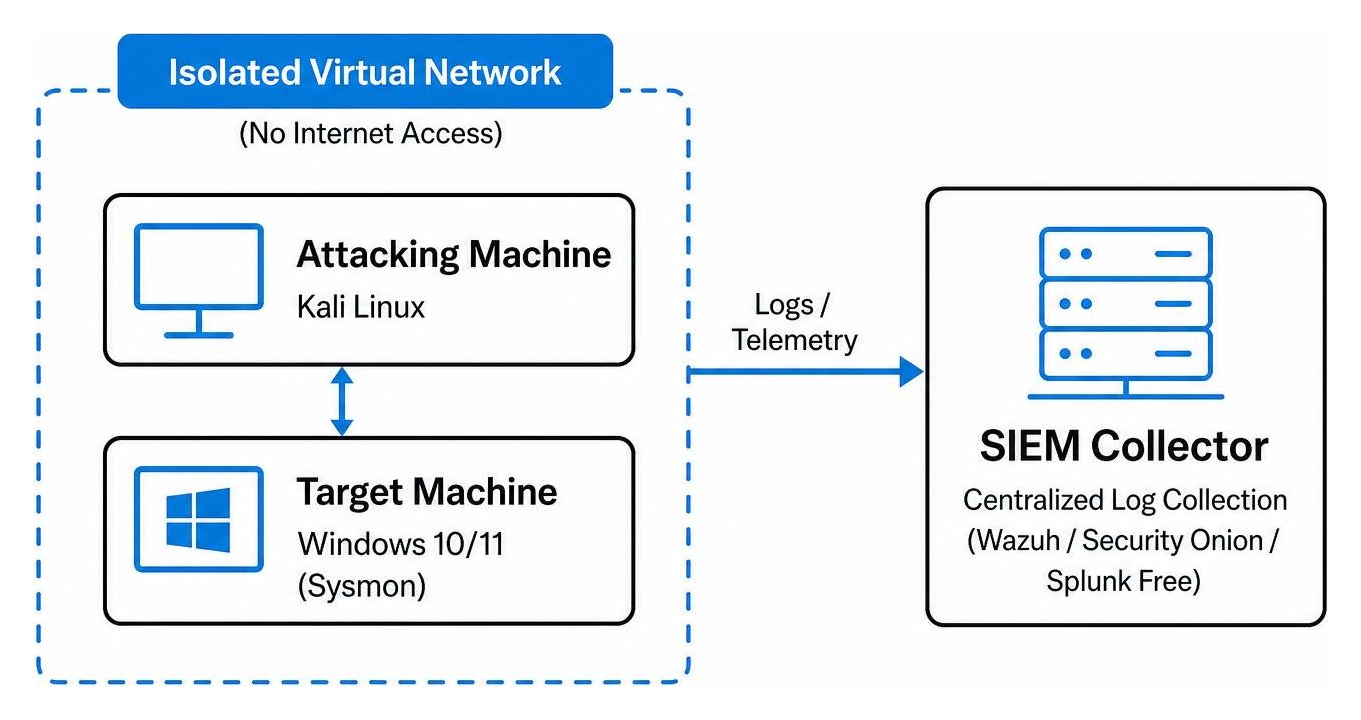
To build a compelling lab environment:
- Deploy Virtual Machines: Run an Ubuntu Linux server alongside a Windows 10/11 client VM on an isolated internal virtual network.
- Install Telemetry Agents: Install Microsoft Sysmon on the Windows client and configure it to record granular process creation, network connections, and registry modifications.
- Deploy a Free SIEM: Stand up a centralized log collector using Wazuh, Security Onion, or Splunk Free to ingest endpoint telemetry.
- Simulate Adversarial Tactics: Execute benign attack simulations using PowerShell or Kali Linux tools, observe the resulting log entries inside your SIEM, and write custom detection rules to catch future attempts.
CTFs, Open Source Projects, and Proof of Competence
Supplement your home lab by engaging in structured, gamified training platforms. Websites like TryHackMe (specifically the SOC Analyst and Defensive Security learning paths) and Hack The Box provide simulated capture-the-flag (CTF) challenges that simulate real-world enterprise infrastructure.
Document everything you build and investigate. Whenever you solve an interactive challenge or create a new detection rule inside your home lab, publish a clear, structured write-up on a personal GitHub repository or technical blog. Your documentation should describe the threat vector, display relevant log snippets, explain your detection logic, and detail remediation steps. Handing a hiring manager a link to five detailed incident write-ups proves your practical ability faster than a four-year diploma ever could.
Step-by-Step Roadmap to Launch Your Cybersecurity Career
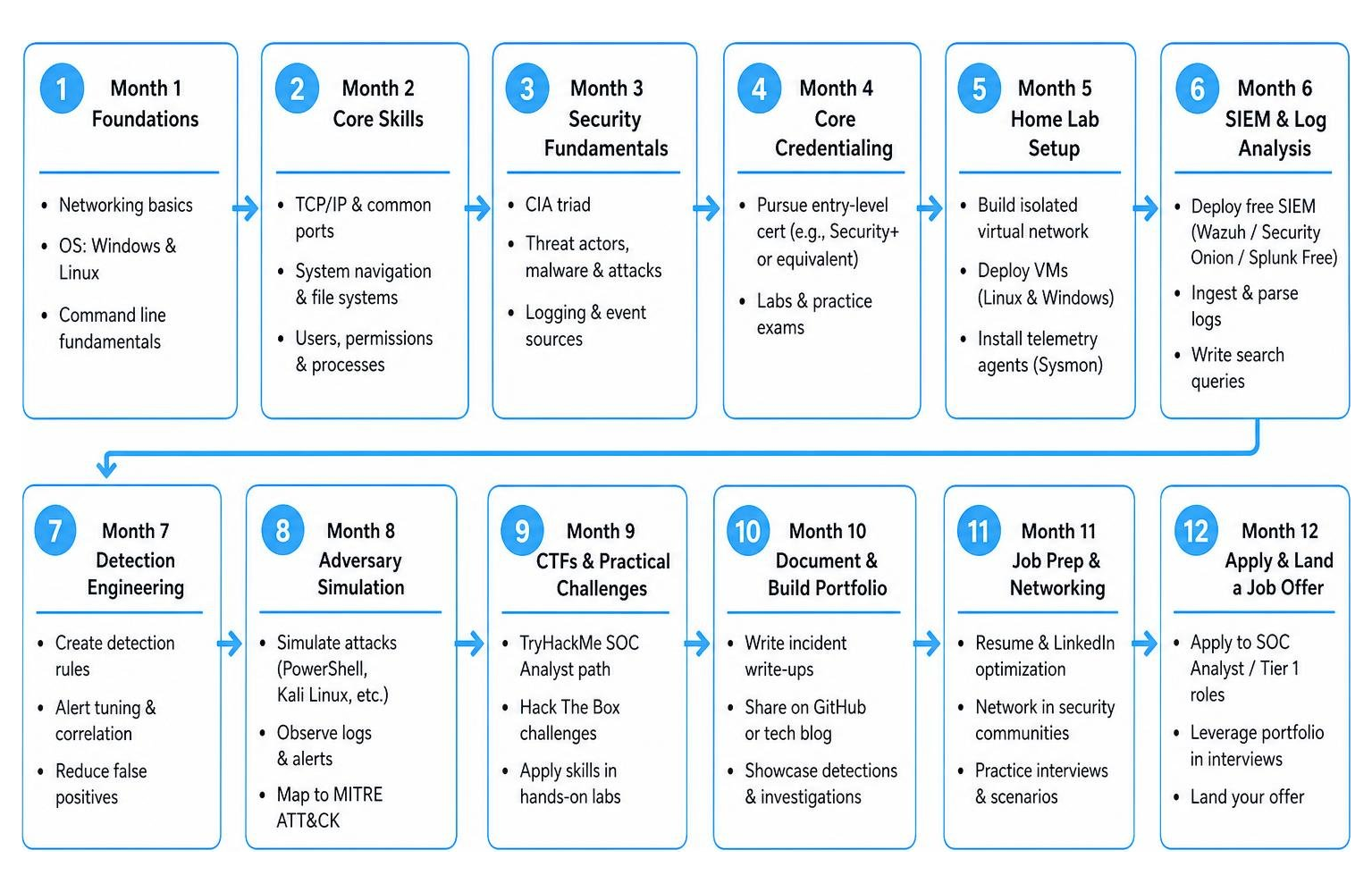
Transitioning into cybersecurity without a degree requires structure and discipline. Following an iterative roadmap keeps your studies focused, prevents burnout, and ensures you produce tangible portfolio assets at every stage. In our work connecting talent with remote tech work opportunities, we have seen that non-degree candidates who follow a structured 12-month blueprint consistently outcompete unstructured self-learners.
Federal employment surveys and workforce reviews archived in the Department of the Interior Reports Repository illustrate that modern technical staffing models increasingly prioritize standardized competency frameworks over formal academic credentials.
Months 1 to 4: Foundations and Core Credentialing
- Master Core Networking and Operating Systems: Dedicate your first six to eight weeks to studying IP addressing, the TCP/IP stack, common network ports, and command-line system navigation across Windows and Linux.
- Study for CompTIA Security+: Use free video resources, practice exam engines, and official study guides to master core cybersecurity principles.
- Pass Your First Certification Exam: Schedule and complete your Security+ exam by the end of month four to establish your foundational credential.
Months 5 to 8: Hands-On Labs and Initial Work Experience
- Construct Your Home Lab: Build your virtualized testing environment, install Sysmon and Wazuh, and generate attack telemetry.
- Publish Project Write-Ups: Post at least three detailed technical analysis reports to your GitHub repository or personal portfolio site.
- Target Adjacent IT Employment: If you do not already work in tech, apply for entry-level IT support, desktop technician, or junior network administrator roles. Gaining enterprise ticket handling experience will accelerate your security transition.
Months 9 to 12: Targeted Applications and ATS Optimization
- Optimize Your Resume: Format your resume as a clean, single-column document without complex tables or graphics that confuse ATS parsers. Place your certifications and hands-on lab projects above education.
- Engage with Technical Communities: Join local security meetups, participate in BSides conferences, and connect directly with security engineers and technical recruiters on LinkedIn.
- Execute High-Volume, Precision Job Applications: Submit tailored applications for junior SOC analyst, vulnerability technician, GRC associate, and MSSP roles, matching your resume keywords directly to each job description.
Frequently Asked Questions About Breaking Into Cybersecurity
Can you get a cybersecurity job with zero IT experience and no degree?
Yes, but landing an analytical role directly from zero background requires disciplined proof of ability. If you have no formal IT experience, your fastest and most reliable route is taking an entry-level help desk or junior systems administration role for 6 to 12 months. This gives you paid, on-the-job experience with enterprise operating systems, access management, and network troubleshooting. Alternatively, candidates who construct exceptional, well-documented home labs showcasing custom SIEM detection rules can occasionally secure tier-1 SOC analyst roles at Managed Security Service Providers (MSSPs) without prior corporate IT tenure.
Which industries are most open to hiring non-degree cybersecurity professionals?
Managed Security Service Providers (MSSPs), defense contractors, healthcare networks, and mid-sized technology companies show the highest willingness to hire skilled non-degree applicants. MSSPs operate 24/7 security monitoring centers that require high volumes of triage analysts, making them natural environments for self-taught talent to prove their capabilities. Defense contractors operating under DoD 8140 guidelines focus on whether candidates hold an active clearance and an approved baseline certification, treating those qualifications as full equivalents to a traditional university degree.
Does not having a college degree limit long-term career growth in cybersecurity?
Not having a degree may impact certain high-level corporate trajectories, but it rarely caps your growth as an individual technical contributor. Senior security engineers, incident response leads, penetration testers, and security architects frequently command salaries well above $140,000 based entirely on their practical expertise, track record, and specialized technical certifications. Where a missing degree can occasionally matter is within rigid enterprise environments or legacy federal agencies when competing for executive management titles like Chief Information Security Officer (CISO). Even then, many organizations accept five to eight years of verified field experience in place of a diploma.
Conclusion
The cybersecurity industry cares about what you can build, defend, and troubleshoot—not where you went to college. As enterprise environments become more distributed and threat actors grow more sophisticated, organizations urgently need skilled professionals who can jump into security tools, analyze alerts, and protect vital business assets.
By securing an industry-standard credential, building an active home lab, and sharing your technical work publicly, you bypass traditional educational barriers. Keep building your skills, stay curious, and regularly check our latest legitimate entry-level remote jobs to discover current cybersecurity opportunities hiring candidates based on demonstrated skill.
